
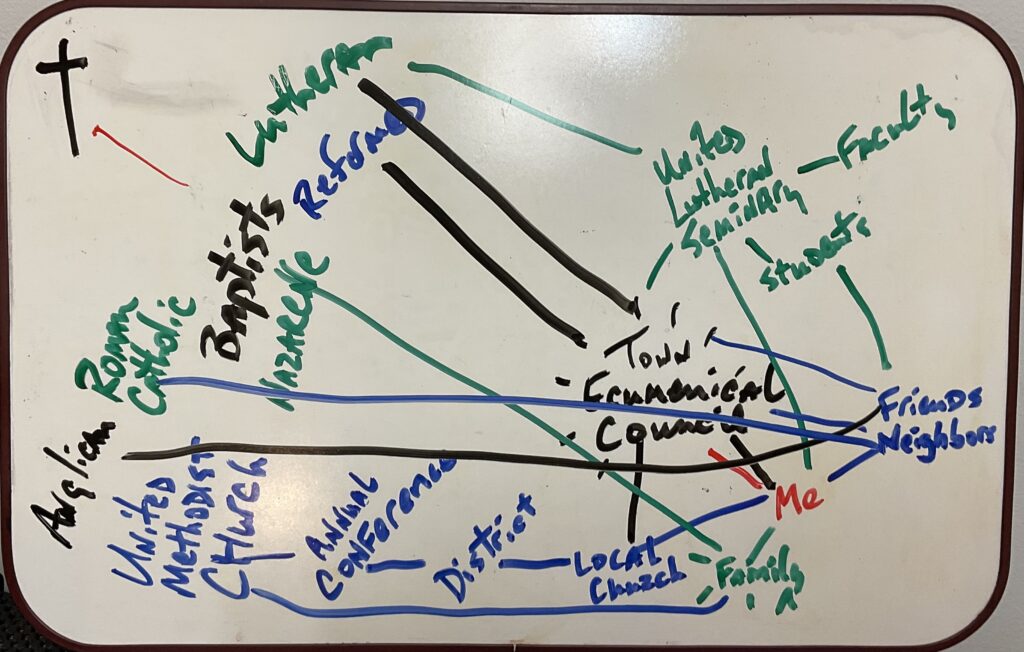
What might a quick sketch of my personal network of relationships and connections in the broken global Body of Christ look like? While my extended family represents many denominations, I pastor in a local United Methodist Church in the USA while serving with neighbors in our town’s ecumenical council of churches. I also presently study in a Lutheran Seminary. When I start sketching the relationships and nodes, I quickly see the mounting complexities and crisscrossing of our historical and theological connections.
It’s always encouraged me that my tradition started as a network of people from multiple denominations. In the 1720s a couple of Anglican brothers at Oxford were cultivating a small, ecumenical gathering to grow in grace and for “watching over one another in love.”1 Calvinists, Moravians, and more joined those Anglicans tenaciously holding one another accountability regarding their discipleship and active involvement in Christ’s work in the world. So tenacious, in fact, they were soon mocked for their “methods” and their “Holy Club.”2
Across the Atlantic from that first ecumenical network of “methodists,” Methodism was institutionalized as a denomination in 1784. But like so many in the ongoing saga of the Body of Christ across history, America’s “Methodist Episcopal Church” developed it’s own history of fractures too.
New to the world of digital network diagramming, I come curious to explore ways the broken global Body of Christ could look representing us digitally across our history and divisions. There are a variety of graphic digital projects online that venture into this diagramming. I see straightforward charts like the “Christian Denominations Tree” from Scrollchart to narrated and interpretive mapping such as Christian Johnson’s Prezi “Mapping Denominational Splits in Christianity.”
While exposing our broken Body, these examples demonstrate how easily we can flatten the nuances of the conflicts that have led to the exponential divisions. In fact, neither make the radical splintering graphically explicit. However, the Scrollchart piece has a subtle but significant note near the bottom: “~45,000 denominations exist today.”3
Mapping that messiness could help us begin wrestling with what this brokenness must look like to heaven’s eyes. C.S. Lewis said,
“If you could see humanity spread out in time, as God sees it, it would look like one single growing thing--rather like a very complicated tree. Every individual would appear connected with every other.”
The rapidly increasing division and separations within the Body of Christ are a terrible converse, or perhaps we could visualize an upside tree. But capturing the roiling historical conflicts and politicization, network diagramming has a potential for actualizing a sense of the dynamic motion of fragmentation while at the same time maintaining the reality of our connection to Christ. More digital network analysis may lend language and concepts that can prompt us to take on better work between the nodes, on the edges, even substantial relationship work where we are.
Technology and AI cannot replace the relational work we must learn to attend across this broken Body. But even these tools are birthing conversations that can help us with better incarnational work on the ground across our differences. For example, notice some of the magnanimous language and practices born from recent “Indigenous Protocol and AI (IP-AI) Workshops. Guidelines include
- Systems of engagement are designed in partnership with specific communities
- There is a circle of relationality and reciprocity when communities are engaged
- A primary concern for responsibility to one’s community is honored
- There is an ongoing respect and support for traditional understandings of trust and care5
While these guidelines are meant to shape AI systems’ engaging with indigenous communities, they articulate powerful ethical approaches to which we can aspire to embody as we network across the edges and between the nodes of our fractured Body of Christ.
Mike Cantley is a PhD student in “Public Theology and Witness” at United Lutheran Seminary in Gettysburg, PA.
1. Ashley Boggan and Christ Heckert, Calling on Fire : Reclaiming the Method of Methodism (Abingdon, 2025). 38.
2. Ibid., xvii.
3. “(Pew / Center for Study of Global Christianity estimate). Eastern Orthodox: ~260M. Catholic: ~1.3B. Protestant: ~900M.” https://scrollchart.com/diagram/christian-denominations
4. C.S. Lewis, Mere Christianity (Macmillan, 1967). 156.
5. Michelle Lee Brown, Hemi Whaanga, and Jason Edward Lewis, “Relation Oriented AI: Why Indigenous Protocols Matter for the Digital Humanities” in Matthew K. Gold and Lauren F. Klein, ed., Debates in the Digital Humanities (Minneapolis: Univ Of Minnesota Press, 2023).78-80.